Showing posts with label history. Show all posts

Tuesday, June 20, 2017

Peruvian Textile

Peruvian Textile

The art of textile making in Peru, has a glorious history dating back to thousands of years, textiles were a highly treasured commodity, largely due to the great amount of labor and care that went into making them. Under the Inca fine fabrics were prized to such an extent that they became regulated by the state and they were the preferred royal gift.

The quality of a fabric in the clothing Andean people wore, as well as the motifs and iconography on their garments signified both social status and cultural identity.
In the highlands were the temperatures drop considerably after sunset, wool from different camelids were preferred. Alpaca was considered finer than llama wool and vicuña wool was judged to be superior to both. In the warmer areas of the coastal region cotton was the preferred material.
Human hair, feathers and metal were sometimes used to decorate the surfaces of fabric.

Netting, a technique for making textiles without a loom, employing loops and knots in the creation of the fabric, May have had its origin in the inventions of the fishing net, as essential tool for the early Peruvians who settled along the coast, where textile manufacture is thought to have begun.
The coastal cultures of Paracas and Chancay produced particularly beautiful textiles, many of them survived to the arid coastal climate, buried as funerary, bundles with mummies. Mummy wrappings, such as those found at Paracas Necropolis, had a special significance.

The bodies of older males were wrapped in the most exquisite fabrics indicating their high status.
Patterns and images of plants and animals may have conveyed information about the deceased’s linage, role in the society and occupation.
The early horizon was a time of great inventiveness in textile design and manufacture as seen in the Chavin culture.

The heddle loom came into use around this time a device that raised and lowered warps so that wefts could be easily inserted.

Chavin design and iconography probably established the wearer’s allegiance to the Chavin cult. The textiles discovered at the seaside cementery of Karwa, for example were probably religious banners, they exhibit Chavin style and incorporate many of the images from Chavin iconography.
Colorful paints were applied directly to these textiles. Interestingly on these banners the Chavin Staff God was depicted as a woman.


The archaeologist Richard Burger that the Karwa saff Doddess may have been sisters, daughter or wife of the great staff of Chavin de Huantar.
To learn more about our Peruvian culture, join our free walking tour every day in Cusco city.

Saturday, June 17, 2017

Corpus Christi Cusco — Spanish Version

Join the biggest Catholic festivity

Corpus Christi en Cusco — Spanish Version

El corpus Christi es una fiesta religiosa que toma encuentra lo tradicional, histórico y simbólico, el cual se celebra el Jueves próximo a la octava de pentecostés, pues al llegar los peninsulares a la ciudad del Cusco bajo la excusa de educar y civilizar e imponer la religión católica como la única y verdadera , y al tratar de dominar su espíritu y ser dueños de su alma usaron el milagro como arma utilizando así a la Virgen y a el Patrón Santiago  que paso de ser “ mata moros a mata indios”; los indios de la época al tener su fiesta principal en el mes de junio denominada Inti Raymi la cual era dedicada al Dios Sol los españoles con la intención de extinguir sus creencias  les impusieron el Corpus Christi y los mal llamados indios al no ser bien adoctrinados mezclaron los cultos denominado a este efecto como el Sincretismo Religioso, pues el  Corpus Cristi se inicia con la salida de la Virgen de Belén acompañada de San José  el domingo de pentecostés  y son llevados en procesión a Iglesia de Santa Clara, en la procesión del día miércoles al mediodía cuando San Antonio llega al  templo de San Pedro para realizar su encuentro con el Patrón  San Pedro para la entrega de llave, los doce imágenes de santos que ya hacen a la espera de la partida de San Antonio como cabeza de la procesión  en el Templo de Santa Clara y la plaza de San Francisco dan inicio a su solemne procesión hacia la Catedral siguiendo un orden tradicional: Para aprender mas de esta tradición Cusqueña, unase a nuestro free walking tour Cusco todos los días y disfrute de sus vacaciones de la mejor manera.
Most people in Cusco are Catholic
  1. San Antonio Abad, santo patrono de la Universidad Nacional y del Seminario,  reside en la Iglesia San Cristóbal.
  2. San Jerónimo,  patrono de los doctores reside en la Iglesia de San Jerónimo.
  3. San Cristóbal, patrono de los indígenas, reside  en la iglesia de San Cristóbal.
  4. San Sebastián patrono de los Champitas (denominación a los residentes del distrito de San Sebastián)
  5. Santa Bárbara patrona de los artilleros y arcabuceros  residente en el Templo del Dulce Nombre de Jesús en el distrito de Poroy.
  6. Santa Ana Patrona del Gremio de carniceros residente en la Iglesia de Santa Ana.
  7. Santiago Apóstol residente en la Iglesia de Santiago.
  8. San Blas patrono de los artesanos residente en la Iglesias de San Blas.
  9. San Pedro residente en la Iglesia del mismo nombre.
  10. San José residente en la iglesia de Belén.
  11. Virgen de Almudena residente en la Iglesia de Almudena.
  12. Virgen de Belén residente en la iglesia del mismo nombre.
  13. Virgen de los Remedios  residente en el Monasterio de Santa Catalina.
  14. La Virgen Purificada residente en la iglesia de San Pedro.
More Catholic Iconography about Catholicism 


Our Virgin is related to the Pachamama
Cada una de estas imágenes está cargada de lujos, deslumbrantes joyas en oro y plata , de bordados hechos a mano, de las mejores flores , bandas encargadas por sus mayordomos los cuales compiten por sobresalir , los de la hermandad de cargadores y danzantes; llegando distinguirse más en sus recorridos en competencia por quien llega primero a la Catedral son los santos  San Jerónimo y San Sebastián  desde tiempos antiguos, pues se inicia con la salida de San Jerónimo  por la madrugada ya que este santo tiene que recorrer unos 10 km y San Sebastián que se encuentra a unos 5km hace la espera correspondiente para el inicio de la competencia hacia el templo de Santa clara; así como también tenemos a las comadres Santa Ana y Santa Bárbara quienes vienen juntas desde Poroy tanto de ida como de retorno.

The horses caused an enourmous impression
En la Catedral desde tiempos antiguos cada imagen tiene una posición designada en la cual se encuentra encabezando el Señor de los Temblores como dueño de casa; según relatos se dice que cada santo y vírgenes estos cobraban vida tomaban forma humana y bajando de sus andas empezaban su reunión  y comenta al Señor de los Temblores también en forma humana como le  fue en todo el año , la situación de los barrios en lo que ellos residen si sus feligreses se comportaban bien o mal si se habían olvidado de ellos o no para que decidieran un castigar o no al pueblo Cusqueño pero según dicen  la Virgen su madre pedía por los Cusqueños para que no los castigue.
Saint Joseph comes from 10k away from
downtown Cusco

Pues el día Jueves el día central muy temprano se realiza una misa interna para después las hermandades de cada santo y virgen los viste y cambia con joyas y ropas de gala para luego tomar posición en el atrio de la Catedral para la Misa y Te Deum realizado por el arzobispado del Cusco al igual que antaño , asisten las autoridades religiosas como las autoridades electas , miembros de la órdenes religiosas masculinas y femeninas así como diversas instituciones; una vez terminada la misa se da inicio a la procesión del Santísimo Sacramento colocado en una carroza de plata  donado por el Obispo Bernardo de Serrada al cual le sigue la procesión de las imágenes que alardean un dominio de sus cargadores para cargar las andas extremadamente pesadas debido cubiertas y repujadas en plata.

Al terminar las procesión las imágenes de los Santos y Vírgenes retornan a la Catedral hasta su octava que es el siguiente jueves donde en el mismo orden en el que hacen su recorrido el día central empiezan a partir, Santa Ana y Santa Bárbara vuelven a partir juntas hacia el templo de Santa Ana mientras que otras imágenes como la Virgen de Belén , San José ,Santiago, San Blas, San Cristóbal con San Antonio ySan Sebastián regresan a sus iglesias el  viernes , el sábado la virgen Purificada con San Pedro y el domingo la Virgen Almudena retorna el domingo.
Our Cathedral in Cusco

Tuesday, May 2, 2017

How to find our Meeting Point in Cusco?

How to find our Free Tour Meeting Point in Cusco?

  • Wherever you are in downtown Cusco, it takes less than 10 to 15 minutes to get to our meeting point by waking, remember that Cusco Downtown is very petite.
  • Do not ask for “walking tours like questions”, if you do so “street tour sellers” will take you to other “walking tour like companies” which don’t even have the authorization from the government to operate, we got it. (colocar el link de los certificados acamba).
  • Ask for Plaza Regocijo-Kusipata* in Spanish you say Sr/Sra. Donde está la Plaza Regocijo?, ask anybody BUT tour sellers, we suggest you to ask the policemen.
  • All people in Downtown Cusco will tell you “it is the same company”, big liars sorry for them BUT we are NOT the same, they don’t even have the authorization from the Government as we do.
  • Once at Plaza Regocijo(Kusipata), Look for the Green Vests ONLY, DO NOT GET CONFUSED.
  • On the google maps it says that we are located at San Agustin street, well this is true BUT this is our office, NOT our meeting point place.
  • Take a screeshot or save this this map so that you can still use when you don’t have internet signal.
See Our Map here or just click here for 3D map 
This is our only one Meeting Point, no other places.
For all walking tours in Lima, Miraflores, Arequipa and Cusco make your booking here.

Tuesday, February 21, 2017

THE CULTURES OF ANCIENT PERU


Ancient Civilizations of Peru

The distant Past

The territory on ancient Peru had been well travelled for more than 10,000 years before the arrival of the Spaniards in the land of the Incas.
At Lauricocha an archaeological site situated at altitude of 13,000 feet in the central Andes, caves have been found in which the first Peruvians found shelter.
In the south they also took refuge in caves, such as those found at Toquepala. Cultural evidence at both sites largely confined to projectile points shipped form stones. The walls of Toquepala’s caves are painted with hunting scenes which date to the early hunting and gathering period.
The Incas’ remotest ancestors were hunters and gatherers. Primitive groups along the pacific coast were especially adept at extracting marine products from the bountiful coastal waters.
They were the descendants of groups of originated in Asia crossed the Bering Strait into North America during the last ice age.
These early Asiatic people dispersed throughout the continent, bringing with them from their native lands the cultural traditions which, by the second millennium BC, would evolve into the first significant Andean civilizations.
Bown with post-firing painting of a human with the body of a feline.
The post-firing technique was often employed by Paracas Culture.
The Vessels were painted with a variety of colours by mixing mineral  pigments with plat resin.
Paracas-Cavers culture, 700 B.C. - 100A.D. 


The First Signs of Civilizations

Miniature stone warrior holding
 a shield and club and wearing a nose  ornament.
Moche Culture, A.D. 50 - 800
During the second millennium BC. , several thousand years after the first humans occupation on the region, the first signs of sedentary civilization began to emerge in Peru, following a shift from hunting and gathering activities to intensive to marine exploitation and then to agriculture. One result of this early manifestation of a more complex social structure was population growth, which in turn necessitated a search for improved irrigation, cultivation and food storage techniques.
Architectural evidence is the best measure of the beginnings of civilization.
Enormous monuments began to rise along the central coast and in the northern region of Peru. Las Haldas for example (around 4000 years old), is a vast pre-ceramic site on the north of coast which included residential areas for the elite as well as ceremonial and communal centers, and the ruins of Caral are even older, apparently dating form 5,000 years ago. Early monumental public architecture emerged in Peru as result of the wishes of the elite, who evidently benefited from the construction of these imposing edifices.
Essentially religious in nature, these structures elevated the prestige of the elite and ensured that their orders would be carefully obeyed. The primary objective of the ruling elite was to increase their own privileges by gaining preferential access to available resources. A secondary result of such rule was the maintenance of the community and guaranteeing for society as a whole.

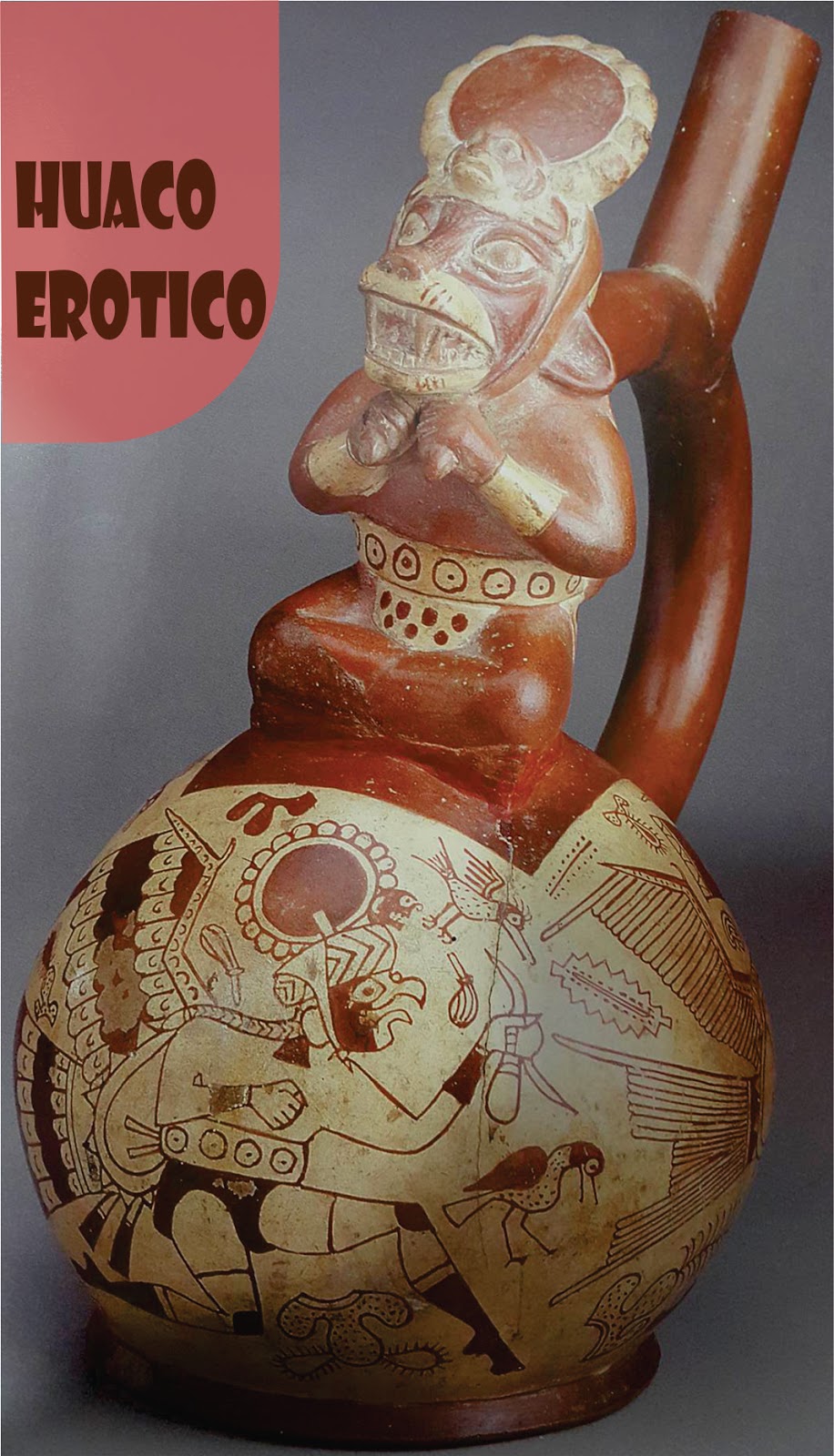
Double-chambered whistling pitcher shaped like a pair of drums.

Ancient Peruvian Civilization

The people from the Andes built large and complex cities, irrigated entire coastal valleys, worked with gold and other metals, wove textiles of intricate beauty, made by clay vessels so vivid that they were sculpture than pottery and mummified their dead.
They did not, however, develop a formal system that we can read today, and most of what we know about them has been learned through a  legacy of architectural remains and the objects of stone, clay, gold, textile and other material which they were buried with their dead. The Spaniards reported on their experiences with the Incas during the conquest and their writings provide us with another valuable source of information.
Researchers have studied artifacts and identified successive artistic styles in their efforts to establish a cultural chronology for their various people on Ancient Peru.
In the past 60 years more sites than ever before have been excavated by professional archaeologists and these have dated to through scientific methods. In the cases of several cultures, we now understand a great deal about people who produced their artifacts, their way of life, their political structures, and even something of their history. In other cases, however, our knowledge remains limited.
And yet, during the thousands of years that people have lived in Peru, inter-regional trade and evolving socio-cultural complexities have led to the spread of similar artistic styles over a wide are. Scholars call the phenomenon of an artistic style which gains widespread acceptance an archaeological horizon: a term used approximate contemporary between distant sites.
In the central Andes Peru, a series of major time periods has been established around the horizon concept. After a nearly period of hunting and gathering, known as the pre-ceramic period, comes the initial period, which is marked by the first use of pottery. This is followed by five periods which cover relatively widespread artistic styles(Early, Middle and Late Horizon), as well as intervening periods of extensive influence of the Inca Empire, and the middle horizon probably reflects a smaller-scale states that were nevertheless fairly large.
The broad similarities between early horizon cultures were most likely due to the adoption of religious cults by emerging elites in different regions of the Andes. The following cultural sequence has been simplified, and includes only the best known cultures, whith emphasis on the coastal and regions. Learn more about Pre - Inca Culture with best private walking tour guided company.


Chavin Culture, 10000 – 200 B.C.

Chavin Culture, 1000-200 B.C.
In the first millennium B.C.  A new architectural and artistic style spread across Peru.
Its beginning may be traced back to the Cupisnique style of the northern Peruvian coast. Similar deities and animal figures have been found on pottery and textiles throughout the country. These elements were brought together and reached their fullest expression and the site known as Chavin de Huantar. It is though that Chavin as the main center of a religious cult, and objects featuring Chavin iconography have been found throughout the Andes. Located at the headwaters of one of the large tributaries of the Amazon which emerge from the high Andes, Chavin could only be reached from the coast by crossing the towering peaks of the Cordillera Negra and the Cordillera Blanca.

Chavin and Cupisnique are characterized by a complex, almost baroque, style which combines human figures with zoomorphic attributes, typically featuring menacing fangs, claws, or beaks. Many of the images were engraved around stone columns or shafts, making them difficult to interpret, and intended for leaders of the cult.
Laern more about our cultures by having a private walking tour to the museum of Pre-Colombian Art.